If you have only ever bought ready-made wholesale clothing and are now thinking of manufacturing your own custom designs, this sourcing guide is built for you. Moving into custom apparel production means taking control of your fabric, fit, and branding, but it also means finding a factory you can actually trust with your money and ideas.
In this full guide, we will walk you through the essentials of apparel manufacturing so your transition into custom manufacturing is as smooth as possible.
Quick Guide to Find a Custom Clothing Manufacturer
Step | Action | Key Focus |
1. Preparation | Create a Tech Pack | Define fabric, sizing, colors, and logo methods. |
2. Sourcing | Search platforms and shows | Target specific regions (e.g., clothing manufacturers in China or Europe). |
3. Vetting | Verify credentials | Ask for factory videos, past work, and quality inspection processes. |
4. Sampling | Order prototypes | Check fabric weight (GSM), stitching, and shrinkage before bulk. |
5. Production | Start small | Place a trial order with a low MOQ clothing manufacturer to test reliability. |
Who Needs a Clothing Manufacturer & What Are Your Core Requirements
Not every buyer needs the same type of factory. Your business model dictates the type of manufacturing partner you should look for.
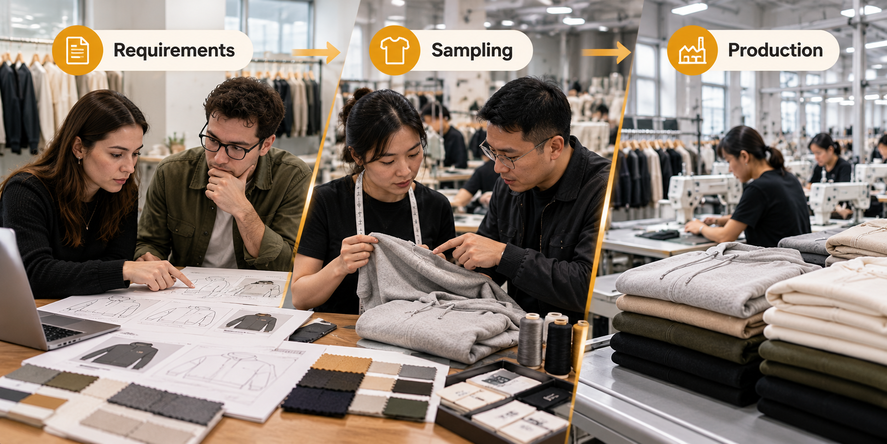
Different types of buyers & their priorities
New brands need flexibility. If you are launching a new line, your priorities are low MOQs, clear sampling guidance, and patient communication. You need clothing manufacturers for startups that allow you to test the market without buying thousands of units.
E-commerce Private Label Brands
Online sellers transitioning from wholesale to their own brand need an OEM clothing manufacturer. Your priorities are stable delivery times, consistent quality, and custom packaging. A reliable private label clothing manufacturer ensures your products look professional when they reach the end customer.
Product Developers
Corporate buyers and procurement managers usually look for ways to optimize supply chain costs. Your priorities include monthly production capacity, strict Acceptable Quality Limit (AQL) standards, and smooth export communication.
Individual Buyers
If you only want one or two custom garments for personal use, a commercial factory is not the right fit. Bulk manufacturers require technical files and minimum order sizes. Individual buyers should look for local print-on-demand shops or local tailors instead.
Define your specs before searching
Do not contact a factory with just a vague idea. Before you ask how much it costs to manufacture clothing, you must prepare your specifications.
Tech Pack: A technical document showing measurements, construction details, and grading.
Fabric Selection: Specify material type (e.g., 100% cotton, polyester blend) and weight (GSM).
Logo Method: Decide between screen printing, embroidery, or heat transfer.
MOQ Target: Know how many units per style and color you intend to order.
Budget: Have a target landed cost (production plus shipping) in mind.
Where to Find Custom Clothing Manufacturers
Finding a factory requires looking in the right places based on your budget and volume.
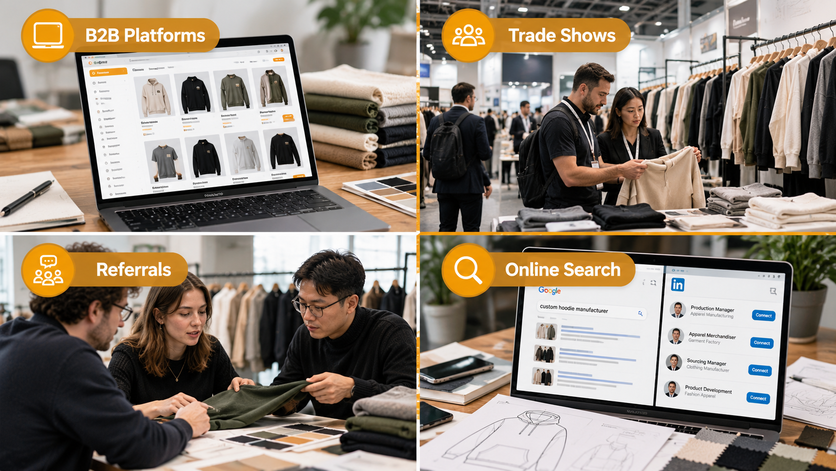
B2B Platforms
Online directories are the most common starting point.
Alibaba & Global Sources: Best for finding overseas clothing manufacturers, especially clothing manufacturers in China. You can filter by verified suppliers and trade assurance.
Foursource & Sewport: Platforms tailored specifically for the apparel industry, connecting designers with global factories.
Maker's Row: Useful if you are specifically looking for local US-based production.
Industry Trade Shows
Meeting suppliers face-to-face is highly efficient. Bring your tech packs and fabric swatches to get immediate feedback.
Canton Fair (China): A massive exhibition for global sourcing.
Premiere Vision (Paris): Excellent for high-end fabrics and European manufacturing.
MAGIC (Las Vegas): A major North American sourcing event for fashion brands.
Referrals & Fashion Communities
Industry networking can reveal factories that do not advertise online.
Reddit (r/streetwearstartup): A practical community where founders share factory reviews, warn against scams, and discuss realistic pricing.
Industry Peers: Other brand owners are sometimes willing to share their supply chain contacts if you do not directly compete with them.
Google / LinkedIn Search Tips
When using search engines, avoid generic terms. Use specific, long-tail keywords to find niche factories.
Instead of "clothing factory," search for "custom hoodie manufacturer in Dongguan" or "heavyweight t-shirt OEM."
Use LinkedIn to search for "production manager" or "apparel merchandiser" to find the actual employees inside the factory, bypassing middleman trading companies.
Domestic vs. Overseas Clothing Manufacturers
Deciding where to produce your clothing impacts your landed cost, lead time, and communication.
Production Region | Pros | Cons |
China | Complete supply chain, low unit costs, advanced logo techniques, fast sampling. | Requires clear technical communication; shipping takes 30-50 days by sea. |
Portugal / Europe | Proximity to EU markets, strong sustainability regulations, fast regional shipping. | Higher unit costs, strict labor regulations limit extremely low pricing. |
USA / Domestic | Fast shipping, "Made in USA" marketing, easy communication. | Highest unit costs, limited domestic fabric availability, high MOQs. |
South Asia (e.g., Bangladesh) | Lowest global unit cost for basic cotton knits. | Very high MOQs (1,000-5,000+), longer lead times, fewer complex custom options. |
Clothing manufacturers in China remain the top choice for brands needing a balance of complex customization, fast fabric sourcing, and competitive pricing.
How to Vet and Screen Clothing Manufacturers
A professional website does not guarantee a reliable factory. You must verify their actual capabilities.
Check factory qualifications & production capability
Confirm what the factory specializes in. A factory that makes denim is usually not equipped to make knitted sports socks. Ask for proof of their facility. Request a video call to see the sewing lines and fabric storage areas. If they refuse to show the production floor, they might be a middleman rather than a source factory.
Key questions to ask a clothing manufacturer
Knowing what to ask a clothing manufacturer saves time and prevents misunderstandings.
What is your MOQ per style and per color?
How long does sampling take?
What is your standard bulk production lead time?
What are your standard payment terms? (Never pay 100% upfront for bulk orders).
Do you follow AQL quality inspection standards before shipping?
Review portfolio, samples & client references
Ask the factory to show examples of their previous work that match your product category. Look at the stitching density, label placement, and fabric quality. A reliable factory will gladly show you physical samples of past production, though they may hide sensitive client logos.
Communication assessment
Assess how quickly and clearly the factory responds. Do they answer your specific questions, or do they send generic copy-paste replies? Can they read and understand your tech pack? Good communication during the quoting stage is a strong indicator of how they will handle production issues later.
How to Contact and Negotiate With Clothing Manufacturers
How you contact a clothing manufacturer determines how seriously they take your brand.
Prepare your inquiry package
Do not send a one-sentence email asking for a price. Send a complete inquiry package that includes:
A brief introduction of your brand.
The specific product category.
Your target order volume.
Your tech pack or clear reference photos.
Your expected delivery timeline.
How to send professional first message
Keep your first message clear and structured.
Factory Tip: Use bullet points for your specifications. State clearly if you need CMT (Cut, Make, Trim - you provide the fabric) or Full Package (the factory sources everything). Full package is generally safer for new brands.
Negotiate MOQ, price, sample cost
Most factories are open to negotiation if they see long-term potential.
MOQ: If the standard MOQ is 500, ask if they will accept a small-batch trial order of 50 to 100 pieces for the first run. (At Suhu Custom, we specialize in flexible small-batch trial orders to help brands test designs safely).
Sample Costs: Custom samples are rarely free. However, you can negotiate to have the sample fee deducted from your final bulk order invoice.
Price: Do not just negotiate the unit price. Ensure you understand the total landed cost, which includes packaging, export support, and shipping.
Clothing Manufacturer Sampling and Pre-Production Checks
Never move straight to bulk production without approving a physical sample.
Sample types (proto / fit / pre-production sample)
The sampling process usually involves several stages:
Proto Sample: The first draft based on your tech pack to check the general design and fabric.
Fit Sample (Size Set): Samples in different sizes to test the grading and fit on actual models.
Pre-production (PP) Sample: The final sample made with the exact bulk fabric, trims, and logo methods. This is your final standard for bulk quality.
Note: Sample development usually takes 3-7 days, depending on product complexity and material availability.
What to check when receiving samples
When your sample arrives, inspect it thoroughly:
Wash and dry the garment 3 to 5 times to check for shrinkage and color fading.
Measure the garment against your size chart to check tolerances.
Inspect logo clarity, especially for complex embroidery or small printed text.
Pull on the seams to ensure the stitching is secure.
Pre-production meeting confirmation
Once you approve the PP sample, confirm all details in writing. Document the exact fabric, hardware, logo placement, and packing instructions. This written agreement protects you if the bulk order deviates from the approved sample.
Common Clothing Manufacturing Risks and How to Avoid Them
Working with factories involves inherent risks. Protect your brand by watching for these common issues:
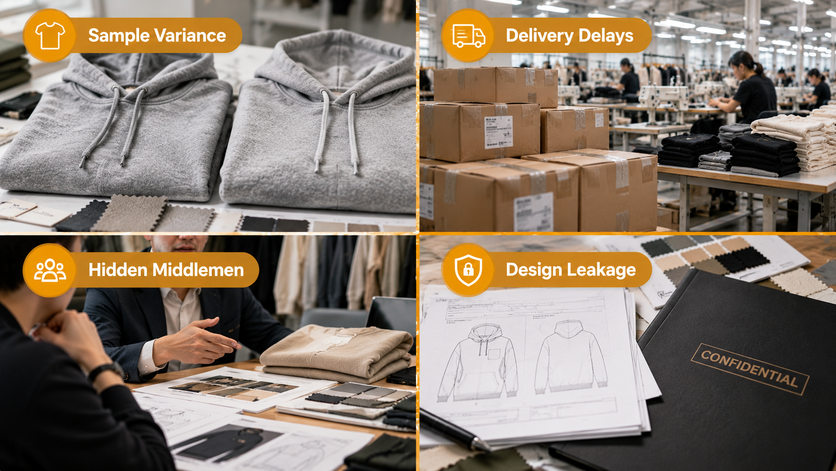
Sample-to-Bulk Variance: Some suppliers make perfect samples but use cheaper materials for bulk. Avoid this by requiring the factory to send a top-of-production (TOP) sample before shipping the rest of the order.
Delayed Deliveries: Factories often prioritize larger clients. Build a 2 to 3-week buffer into your timeline and put late-delivery penalties in your purchase order.
Hidden Middlemen: Trading companies mark up prices and slow down communication. Look for direct source factories that own their equipment.
Design Leakage: Protect your intellectual property by signing a design confidentiality agreement before sharing your tech packs.
Conclusion
Finding the right apparel manufacturer takes research, clear technical documentation, and careful sampling. By vetting suppliers thoroughly, asking the right questions, and enforcing strict sample-to-bulk quality control, you can build a reliable supply chain for your brand.
If you need a direct source factory that handles everything from fabric sourcing and custom logos to private-label packaging and export support, Suhu Custom can help. Based in Humen, Dongguan, we provide direct factory communication and support small-batch trial orders without trading-company markups.
Prepare your tech pack, target quantities, and fabric requirements before reaching out to factories so you can get accurate pricing immediately.